01
Curiosity
Spark wonder, welcome questions, and let children explore English without pressure.
Playful Learning helps ALTs create joyful, safe, and meaningful English experiences for young children. Because the feeling of learning lasts longer than a vocabulary list.

Every child learns best when they feel safe, engaged, and free to explore.
“Playful” does not mean random or noisy. It means child-centered, emotionally warm, intentionally simple, and alive with discovery.
Spark wonder, welcome questions, and let children explore English without pressure.
Create a warm, predictable space where every child feels safe enough to participate.
Teach through bodies, songs, gestures, play, and the joyful energy of the room.
Make room for imagination, expression, and many different ways to understand.
Celebrate languages, cultures, and the bridges children build between them.
The goal is not to perform a perfect lesson. The goal is to become a safe, playful presence in the child’s world.
PRESENCE BEFORE PERFORMANCEObserve first. Notice energy, emotion, and what the room needs.
Keep it simple. Use fewer words, clearer gestures, and familiar routines.
Join the child’s world. Sit on the floor, play, move, and build trust.
Work as one team. Follow the homeroom teacher’s lead on discipline and safety.
Look beyond the behavior. Every action has a reason. Start with curiosity, not correction.
Model once more, keep the rhythm, and turn the repetition into a simple chant or action.
Remember: Understanding the reason does not remove the boundary. It helps you choose a response that works.
When a child is distressed, connection comes before explanation. Use five simple steps and keep the homeroom teacher close.
“Hmm. I see.”
The ALT does not decide alone. Use the level that fits the moment and coordinate with Japanese staff.
Mild upset. Stay present, use simple English and gestures, then continue the activity.
Crying continues or behavior escalates. Pause, reduce stimulation, and signal the homeroom teacher.
Safety risk, injury, panic, or leaving the area. Call the homeroom teacher immediately.
A calm adult regulates the room faster than a loud one. Adaptation is professionalism, not failure.
Lower your voice, reduce your pace, and stop competing with the noise.
Use fewer words, one clear gesture, and one familiar instruction.
Move to a familiar song, quiet choice, movement break, or simple ending.
Use a familiar shape. Adjust the timing to match the children in front of you.
Greet, connect, and use a familiar opening.
Wake up bodies with a song or action cue.
Explore one clear language target through play.
Choose a calm task, story, or seated review.
Review, celebrate, and finish with the same goodbye.
Practical guidance for the moments that rarely appear in a lesson plan: sudden tears, restless bodies, changing schedules, big groups, and small breakthroughs.
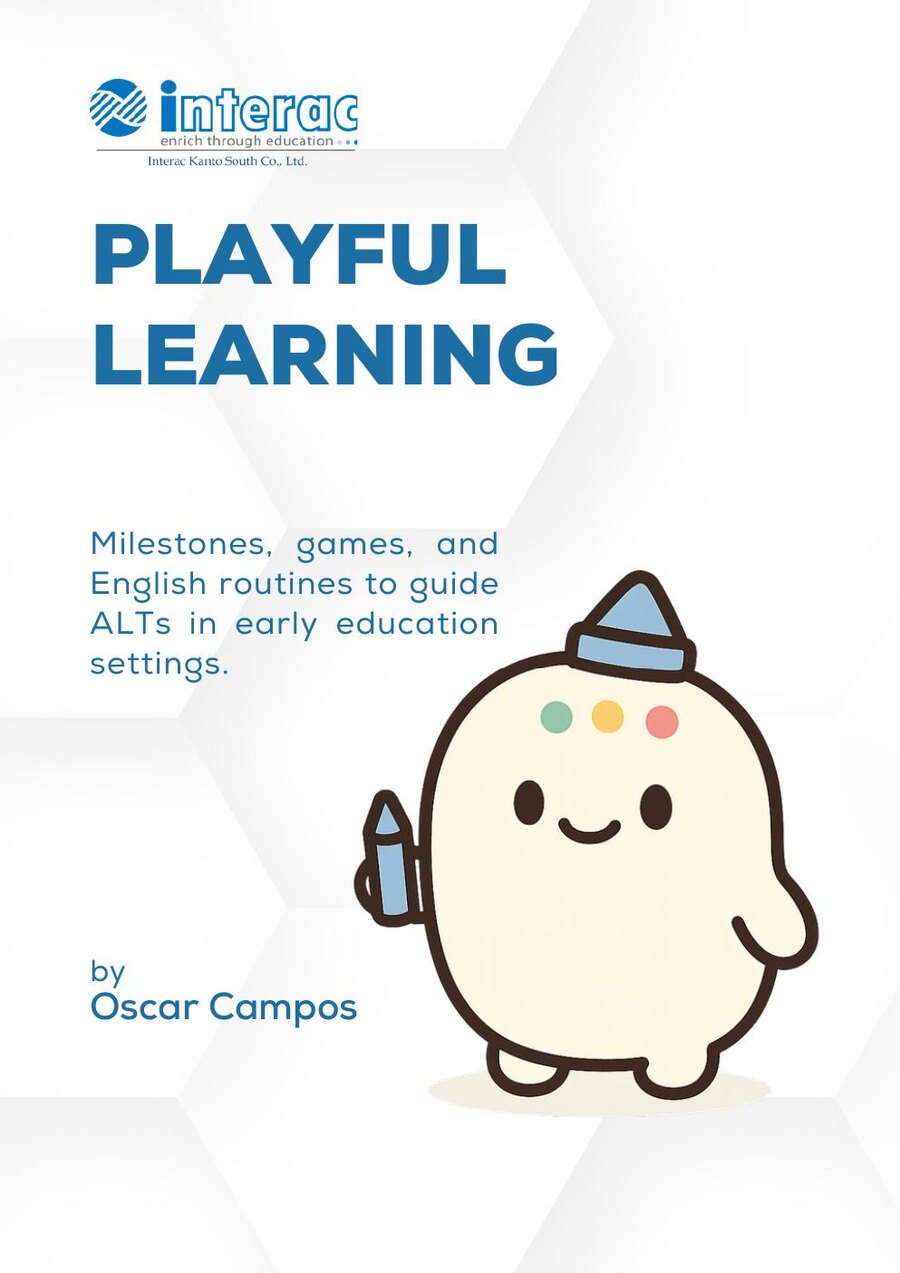
Milestones, classroom roles, routines, games, safety, and practical guidance for ALTs in Japanese early education.
Open handbook ↗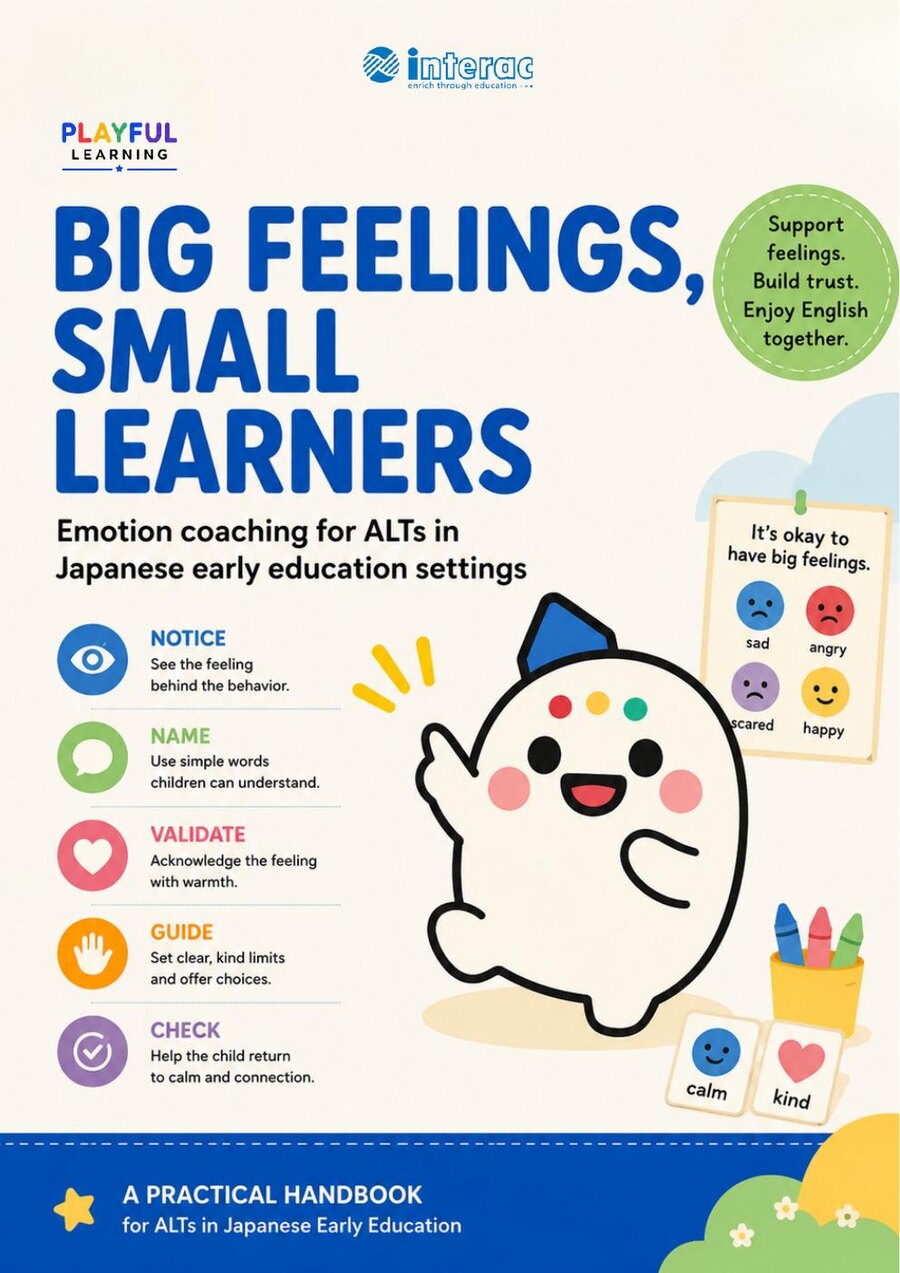
A clear five-step response for meeting strong emotions with low language, high warmth, and professional boundaries.
Open handbook ↗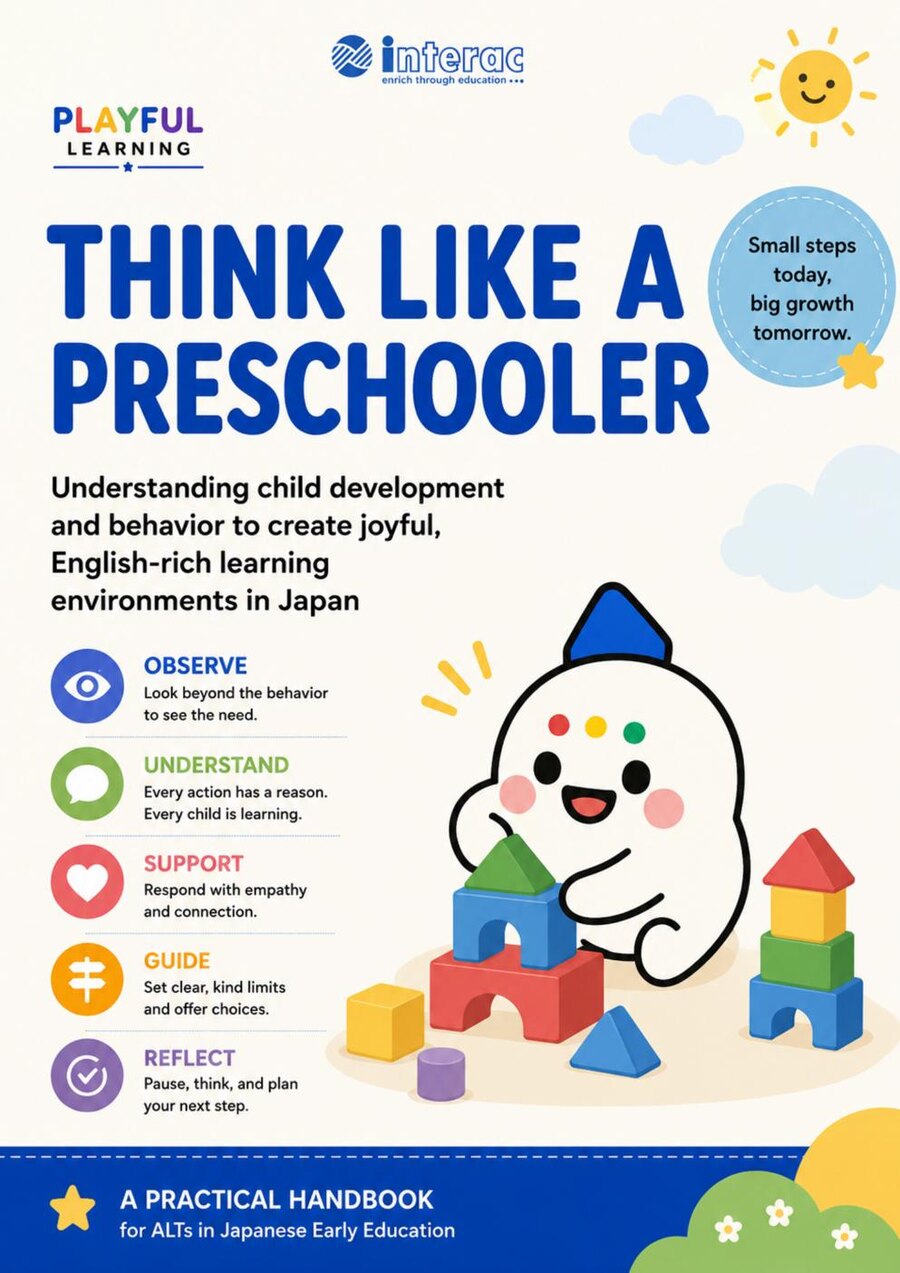
Turn behavior into useful information and respond in ways that fit the developing preschool brain.
Open handbook ↗Open ready-to-use materials in Google Drive, or play Playful Learning songs and Deep Dive episodes without leaving the site.
Visit ALT ClassroomOpen the full YouTube channel↗Movement-ready action cards for energetic, low-language practice.
Open flashcard folderVisual prompts for naming feelings and supporting emotional language.
Open flashcard folderClear, child-friendly cards for daily routines, songs, and games.
Open flashcard folderHow it works: Open a folder, choose the PDF set you need, then use Google Drive’s download button. Sign in with your work account if prompted.
Perhaps it is the memory of moving to a silly song. The first moment English felt safe. The feeling of being seen, welcomed, and brave enough to try.
Mogu reminds us to Move, Observe, Grow, and Understand. Cheerful, curious, and warm, Mogu celebrates every small step.